Kopac
Connecting art and humanity through the works of visionary creators, celebrating free expression and authentic emotion.
info@artrencontre.com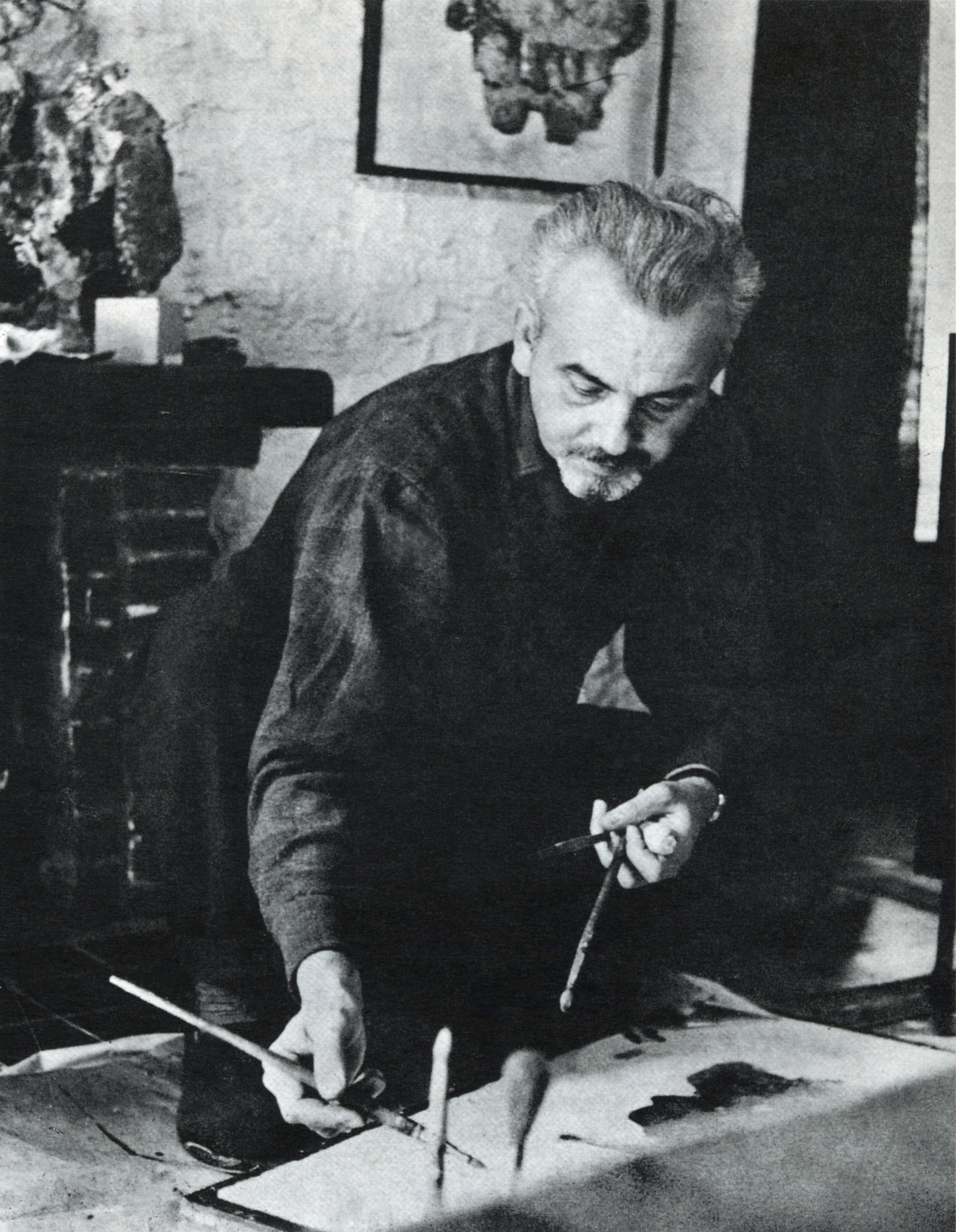
Kopac Biography
Franco-Croatian artist Slavko Kopac, born in 1913 is an enigmatic and complex figure who embodied the innovative and interdisciplinary spirit of an era of cultural rebirth from the ruins of the postwar period.
Slavko Kopac and Postwar Florence: a laboratory of experimentation (1943–1948)
Slavko Kopac trained at the prestigious Academy of Fine Arts in Zagreb, the successor to the Royal National College of Arts and Crafts founded in 1907. In a context deeply influenced by the Viennese Secession and the ideals of the Bauhaus, Kopac absorbed the cultural stimuli of the former Austro-Hungarian Empire. At just 15 years old, he was profoundly struck by a monograph on Egon Schiele, which became a decisive source of inspiration for him.
After completing his studies and participating in the 1942 Venice Biennale, in 1943, in the midst of the war, Slavko Kopac arrived in Florence, a city where the Renaissance heritage coexisted with a burgeoning drive toward modernity. Enrolling at the Accademia di Belle Arti, he immersed himself in a rich and dynamic cultural environment, which led him to progressively abandon the Impressionism of his early paintings and embark on a quest for formal innovation and the expressive intensity of color.
In Florence, Kopac came into contact with significant Italian artists such as Felice Carena and Giovanni Colacicchi. Despite wartime restrictions, the Florentine scene offered him opportunities to visit important exhibitions and galleries, including Il Fiore. Events such as the French Painting in Florence exhibition, organized by Bernard Berenson in May 1945 at Palazzo Pitti, exposed him to the masterpieces of Cézanne, Rouault, Derain, Chagall, and Cocteau, discoveries that profoundly nourished his research. Within this context, he experimented with diverse techniques and forms, exploring graphic, pictorial, figurative, and imaginative universes.
In drawing, Kopac distinguished himself with works of extraordinary variety: his lines alternated between fluid and monumental or nervous and expressive. At the same time, he reinterpreted traditional themes with a modern sensibility. In Crucifixion, exhibited at the Prato Prize in 1946, the stylized forms of Christ twist in a motion verging on the dance-like. Kopac sought a language capable of expressing his worldview, reflecting a wide range of influences: Giotto, naïve art, Etruscan art, De Chirico, Cézanne, Klee, Kandinsky, Ernst, Sironi, and Morandi, the latter exhibited by Roberto Longhi at the Il Fiore gallery in 1945.
Parallel to this, the artist explored a symbolic dimension in his representations of animals and astral forms, drawing inspiration from Slavic folk legends. In his works, animals and celestial bodies are not mere subjects but archetypal symbols. Works such as Horses (1947) and Deer at the Spring (1947–48) interpret nature as a universal symbolic language. Constructed with contrasting colors, his palette is vibrant, and his works emanate expressive power and intensity.
Paris: from 1948 to informal art
In 1948, Slavko Kopac settled in Paris, the undisputed capital of European art in the postwar period. There, he immediately came into contact with key avant-garde figures such as Jean Dubuffet and André Breton. This placed him at the heart of major artistic debates, but true to his independent nature, Kopac chose to remain on the margins of official movements, preserving his creative autonomy.
His collaboration with Jean Dubuffet led to a deep involvement in the project of the Collection de l’Art Brut, a revolutionary initiative that elevated the art of outsiders and posed a radical reflection on the very origins of art. Although he worked as a curator, Kopac transformed this experience into a source of personal inspiration, incorporating the instinctive and unconventional approaches of Art Brut creators into his own artistic practice.
In works such as Homage to Christopher Columbus (1949), Kopac’s language is defined by the essentiality of line, the incisiveness of form, and the use of saturated colors, which imbue the compositions with extraordinary immediacy. His practice became a means to explore gesture and sign as primordial expressions, revealing a profound connection between graphic forms, spontaneity, and the unconscious. Works such as Graffiti or The Jungle (1949) reflect his interest in automatic and instinctive gestures, rooted in an archetypal dimension. Kopac engaged in dialogue with figures such as Brassaï, André Masson, Dubuffet, and Henri Michaux, sharing with them an exploration of spontaneous mark-making as a universal language.
The artist also interacted with Surrealism, finding a natural affinity between his own imagery and the poetic universe of the movement. Although he did not formally join the group, his works were deeply appreciated by the Surrealists for their ability to evoke fantastic and totemic worlds, populated by scratched figures, wild jungles, and monumental cows. The masks recurring in his works evoke a ritualistic component closely tied to the Surrealist interest in collective rites as a means of accessing the unconscious.
Kopac produced numerous monotypes, frottages, and decalcomania techniques that place him in continuity with Surrealism. The book The Sun Sets in the Land of Elephants (1951), a rare visual poem, composed of woodblock engravings enriched with gouache highlights and bound with colored raffia, embodies Kopac’s fantastic and totemic vision, earning the admiration of André Breton, who welcomed it into his collection.
Over time, Kopac deepened his exploration of materials, experimenting with their expressive potential through innovative solutions: enamels on volcanic stone (Lava, 1955), melted lead shaped into floral forms (Black Earth, 1961), and fragments of tires transformed into a fantastical creature (Werewolf, 1962). The artist played with depth and texture; his technique reflected a synthesis of poetic and material elements, intertwining the real with the fantastic. Forms dissolved, moving from descriptive to evocative, meditative, and enigmatic. This approach impressed critics and artists such as Michel Tapié, who identified in Kopac’s works a dialogue with artists like Jackson Pollock, Lucio Fontana, and Sam Francis.
In his transnational position, Kopac transcended stylistic and cultural boundaries, weaving Slavic symbolism with the rebellious energy of historical avant-gardes, intent on breaking academic conventions and exploring psychic automatism. At the same time, he engaged with the postwar avant-garde’s focus on material expressivity, introspection, and the aesthetics of Informal Art.
1913
Slavko Kopac was born on 21 August 1913 in Vinkovci, Eastern Slavonia (Croatia), to Stefano Kopač and Ana Klein, part of a family of merchants.
1927
Kopac attended high school in Vinkovci and took drawing classes from Vinko Pajalić.
1933 – 1937
Kopac enrolled at the Royal Academy of Fine Arts in Zagreb, where he studied painting with Vladimir Becić, a leading figure of Croatian modernism who had trained in Paris.
1939
Awarded a scholarship by the French government, Kopac moved to Paris for nine months. There he met Croatian painter Leo Junek (1899 – 1993), whose tachist style influenced some of his work. He focused intensely on the still life and landscape painting.
The Nazi invasion of France in June forced Kopac to return to Croatia as a foreign national.
1940
He taught art at the Mostar grammar school (Bosnia-Herzegovina), then at the classical grammar school in Zagreb. He took part in both solo and group exhibitions.
1942
He exhibited at the 22nd Venice Biennale as a representative of the Independent State of Croatia, engaging with the Italian and international art scene.
1943
Kopac obtained unpaid leave and a scholarship from the Italian Ministry of Foreign Affairs. He enrolled at the Academy of Fine Arts in Florence in May 1943.
He studied under Giovanni Colacicchi, a painter and intellectual active in antifascist circles.
1944 – 1945
Kopac attended a fresco workshop at the Institute of Art in Florence, producing works that mark a shift from an Impressionist language towards more abstract chromatic and compositional solutions.
1945
Kopac had his first solo exhibition at Galleria Michelangelo in Florence.
Giovanni Colacicchi wrote the first critical article on him in Italy, published in Corriere del Matino.
Kopac collaborated with architect Giovanni Muzio and sculptor Ivan Meštrović, among other artist, in the realization of decorations for the Church of Santa Maria Mediatrice in Rome.
1947
Kopac exhibited with Fiore de Henriquez at the Galleria Rizzi in Florence (15 – 28 February) and the Galleria della Strega in Trieste (19 Aprile – 4 May). In the same year, he took part in the Premio Torino – Italian Art of Today (15 February – 15 March), a landmark of artistic renewal, and in the First Arte d’Oggi exhibition at Galleria Firenze (3 – 14 May), alongside Bargheer, Berti, Lardera, Venturi and others.
Kopac co-founded the Florence section of the Art Club, an international network of artist engaged in abstraction, graphic experimentation, and poetic research.
1948
Kopac exhibited in Florence and Rome: it marks the beginning of a poetic and visionary shift in his language. With the support of Bernard André, French vice-consul and key figure of the Art club, he obtained a visa for France and in August moved to Paris.
In Paris, introduced by Giordano Falzoni, Kopac met Jean Dubuffet. A lasting friendship began.
Dubuffet, together with André Breton, Jean Paulhan, Michel Tapié and others, founds the Campagnie de l’Art Brut, an association dedicated to the systematic study of the works of “irregular” authors: figures standing outside the official art system, compelled by an irresistible inner necessity, whose creations are marked by a radical inventiveness.
Dubuffet included a text on Kopac in the Almanach de l’Art Brut and appoints him secretary and first curator of the Art Brut collection he had assembled.
1948 – 1951
Kopac investigated the aesthetic potential of matter – impasto, enamel, ceramics, lava, and printmaking – while drawing closer to the Surrealist group.
In 1949 he illustrated André Breton’s poem “Au regard des divinités” and exhibited at Galerie Messages in Paris. The following year he took part in the Almanach surréaliste du demi-siècle, thus starting a collaboration and forging a friendship with Breton that would continue in the years to come.
On 8 October 1951, the Compagnie de l’Art Brut is dissolved. Dubuffet moved to New York as a guest of the artist Alfonso Ossorio, taking with him the 1.200 art brut works from his collection. Kopac compiled the inventory, preparing a card for each work in anticipation of the journey.
1952
Art critic Michel Tapié included Kopac in his essay “Un Art Autre” recognizing him as one of the leading figures of Art Informel alongside Fautrier, Wois, Michaux, Burri, de Kooning, Soulages, and Dubuffet. In the same year he took part in the exhibition of the same name at Studio Facchetti in Paris.
Kopac met his future wife, Paulette, who runed a cheese shop in Paris, with whom he will have a son, Laurent.
1953 – 1955
The Surrealist gallery À l’Étoile scellée devotes three exhibitions to Kopac: In Paris (1953, with an introductory text by Benjamin Péret, and 1955) and in Lima (1954).
Kopac bought a house in Vence, in the South of France, where Dubuffet had established his studio. There he met the gallerist Alphonse Chave, who would later devote numerous exhibitions to his work.
1960s
Kopac took part in the exhibition petit bal de têtes at Galerie Chave, alongside some twenty artists including Hans Bellmer, Alberto Giacometti, Asger Jorn, and Karel Appel.
Kopac met Annie Le Brun, a French writer, poet and critic associated with Surrealism with whom he forged an indissoluble friendship, while his close bond with Breton remained strogn.
Le Brun will later dedicate numerous writings to Kopac.
Kopac’s research turned towards the density of matter and the use of new materials: tyers, lead, and papier-mâché.
1962
On 24 September 1962, the Compagnie de l’Art Brut was re-founded in Paris by Jean Dubuffet, Asger Jorn, Raymond Queneau, Slavko Kopac and others. Kopac is appointed administrator and curator of the collection, housed in a large hôtel particulier purchased by Dubuffet on rue de Sèvres. His duties will include selecting artist and works, compiling inventories, managing archives, and welcoming visitors. That same year, be obtained French citizenship.
1963
Kopac exhibited at the Galerie Mona Lisa in Paris. The catalogue includes an extensive critical text by Michel Ragon.
1966
After long decades of absence, Kopac returned to his homeland with an exhibition at the Moderna galerija in Rijeka.
1970s
The transfer of the Art Brut collections to Lausanne, where the Collection de l’Art Brut is inaugurated in 1976, marks a turning point in Kopac’s life. He decided to devote himself entirely to his artistic research, while remaining for a long time a member of the Swiss museum’s advisory board alongside Dubuffet.
1977
The Museum of Modern Art in Zagreb dedicated a retrospective exhibition to Kopac, featuring about four hundred works, curated by Mladen Pejaković.
1981
At the Paris Art Center in Paris, Ante Glibota curated a Kopac retrospective presenting 169 works.
1985
Jena Dubuffet died on 12 May. The exhibition Salut à Jean Dubuffet at Galerie Chave paid tribute to the friendship between the two artists.
1988
Kopac exhibited a selection of sculptures at the 24th Seoul Olympic Art Festival (17 September – 2 October).
1990s
Despite the progressive deterioration of his health, Kopac continued to produce paintings, collages, sculptures, and assemblages. He supported the donation of his works to the Klovićevi Dvori Gallery in Zagreb, works that had been collected by Dubuffet during his lifetime and transferred to Lausanne together with the Art Brut collection.
1995
Kopac passed away on 23 November 1995. The following year, the Association pour la promotion des arts honored his legacy with a retrospective at the Hôtel de Ville in Paris.
1997
Biserka Rauter-Plančić and Annie Le Brun curate the exhibition Slavko Kopač at the Klovićevi Dvori Gallery in Zagreb, accompanied by the publication of his first monograph.
2002
The Musée de Vence-Fondation Emile Hugues presented Kopac’s work alongside that of Dubuffet, Max Ernst, Henri Matisse, Sol LeWitt, and Claude Viallat.
2017
On 30 June 2017, in Paris, at Hôtel Drouot-Richelieu, Digard Auction held the Jean Dubuffet & Atelier Slavko Kopac auction, with 165 lots, including 1.560 works by Kopac.
2019
Tamara and Kristijan Floričić and Maja Ivić found the association ArtRencontre, dedicated to preserving and promoting Kopac’s art, and create an important collection.
2021 – 2023
The Centre Pompidou acquired twelve works by Kopac, with the support of director Bernard Blistène and Sophie Duplaix, Chief Curator of Contemporary Collections.
Fabrice Flahutez, Pauline Goutain and Roberta Trapani published a monograph with Gallimard, with the support of the Association ArtRencontre, and found the Kopac Committee Association, devoted to the study of Kopac’s art.
In 2021 – 2022, a major retrospective is co-organized by Association ArtRencontre at the Meštrović Pavilion in Zagreb, accompanied by an international conference and a parallel exhibition at the French Institute in Zagreb.
In 2022, Kopac’s work is exhibited as part of the exhibition Sur les pas de Jean Dubuffet en Auvergne at the Musée d’Art Roger-Quilliot in Clermont-Ferrand.
In 2022 - 2023 Kopac’s work is featured in the exhibition Chercher l’or du temps: surréalisme, art naturel, art brut, art magique at LaM – Lille Métropole Musée d’art moderne, d’art contemporain et d’art brut (14 October 2022 – 29 January 2023)
2025
In July 2025, the documentary Slavko Kopac: Barbaric Refinement (Croatia, 2025, 110min.), directed by Dražen Majić and produced by Association ArtRencontre was presented at the Pula Film Festival.
In September 2025 more than one hundred Kopac’s works were presented in the grand exhibition Slavko Kopac: Hidden treasure. Informal Art, Surrealism, Art Brut held in Florence, co-organized by Association ArtRencontre and Accademia delle Arti del Disegno ( 12 September – 13 November), followed by the publication of the accompanying book Slavko Kopac – Il Tesoro Nascosto, published by 5 Continents Editions.