
Kopac
Connecting art and humanity through the works of visionary creators, celebrating free expression and authentic emotion.
info@artrencontre.comKopac Archive
Explore exhibitions, publications, and interviews that illuminate the artist's journey — from early works to international recognition.
Exhibition Timeline
1938 - 1939
Slavko Kopac and Mladen Veža, collective exhibition, Salon Edo Ullrich (Ilica 40), Zagreb, 1 – 12 June,1938.
Watercolors and oils by the young painter Slavko Kopac (Akvareli i ulja mladog slikara Slavka Kopaca), House of crafts (Obrtnički dom), Vinkovci, September 1938.
Half a century of Croatian art (Izložba pola vijeka hrvatske umjetnosti), group exhibition, Pavilion of arts, The Meštrović Pavilion (Dom hrvatskih likovnih umjetnika), Zagreb, 18 December 1938 – 31 January, 1939.
14th exhibition of Croatian artists (XIV Izložba hrvatskih umjetnika), group exhibition, Vladimir Becić, Bruno Bulić, Ivan Domac, Oskar Herman, Ivo Kerdić, Slavko Kopac, Miron Makanec, Marijan Matijević, Antun Mezdjić, Pavao Perić, Ivo Režek, Vilko Šeferov, Ljudevit Šestić, Zlatko Šulentić, Mladen Veža, House fine arts (Likovnih umjetnosti TRG kralja Petra), Zagreb, 21 October – 25 November 1939.
1940
First Annual exhibition of Croatian artists (I Godisnja izložba hrvatskih umjetnika), collective exhibition organized by the Croatian Society of Arts (Priredilo hrvatsko drustvoumjetnosti), publication under the direction of Ivo Šrepel, Joza Kljaković and Jela Tadijanović, House of Fine Arts (Likovnih umjetnosti TRG kralja Petra I Velikog Oslobodioca), Zagreb, 19 May – 22 June 1940.
1941
First Exhibition of Croatian artists in the independent state of Croatia (I Izložba hrvatskih umjetnika u neufavisnoj državi hrvatskoj [NDH]), group exhibition organized by the Independent State Art Gallery from Croatia to Zagreb (Priredila galerija umjetnosti
nezavism države hrvatske u zagrebu), publication under the direction of Professor Ivo Šrepel, Pavilion of arts (Umjetnički paviljon / TRG kralja Tomislava), Zagreb, November 9-30, 1941.
1942
XXIII Venice Biennale, Antonio Maraini (dir.), group exhibition with a painting on canvas by
Kopac entitled Chiostro dei gesuiti a Zagabria (Cloister of the Jesuits in Zagreb), curator for Croatia: Vladimir Kirin, 21 June – 20 September 1942 (the work is reproduced on p. 305 of the catalogue; Florence: Carlo Cya Editore, 1946).
Impressions of the Battlefield. “Painters Experience the War” ((Slikarski dojmovi sa ratišta. Maler Erleben den Krieg), group exhibition of works by German and Croatian war painters, held under the honorary patronage of collaborator and Field Marshal Slavko Kvaternik and the German Ambassador of the Senior Group Leaders of the SA Unit Siegfried Kasche,
Palača HAZU, Zagreb, 22 July – 11 August 1942.
Second Exhibition of Croatian Artists in the Independent State of Croatia (II Izložba hrvatskih umjetnika u nezavisnoj državi hrvatskoj [NDH]), group exhibition organized by the Art Gallery of the Independent State of Croatia in Zagreb (Priredila galerija umjetnosti
nezavisme države hrvatske u zagrebu), publication edited by Professor Ivo Šrepel, Pavilion of Arts (Umjetnički paviljon / TRG kralja Tomislava), Zagreb, 22 November – 13 December 1942.
1943
Croatian art exhibition (Ausstellung kroatischer Kunst), collective exhibition with the participation of Ivo Šrepel, [Preussische Akademie der Künste Berlin Unter den Linden 3], Zagreb, 27 January – 25 February 1943.
Croatian art exhibition (Ausstellung kroatischer Kunst), collective exhibition with the participation of Ivo Šrepel, Künstlerhaus, Vienna (Beč), 21 April – 31 May 1943.
Croatian art exhibition (Vystava chorvatskeho umenia [Izložba hrvatske umjetnosti]), collective exhibition with the participation of Ivo Šrepel, Agricultural Museum Slovenian (Slovenské Pol’nohospodárske Múzeum), Bratislava (Slovakia), 3 June – 1 July 1943.
Third Exhibition of Croatian artists in the state independent of Croatia (III Izložba hrvatskih umjetnika u nezavisnoj državi hrvatskoj [NDH]), exposure collective, Croatian State Art Gallery (Hrvatska državna galerija umjetnosti), Arts Pavilion (Umjetnički paviljon / TRG kralja Tomislava), Zagreb, 10 – 31 October 1943.
1944
Fourth Exhibition of Croatian artists in the state independent of Croatia (IV Izložba hrvatskih umjetnika u nezavisnoj državi hrvatskoj [NDH]), exposure collective, Croatian State Art Gallery (Hrvatska državna galerija umjetnosti), Arts Pavilion (Umjetnički paviljon / TRG kralja Tomislava), Zagreb, 17 June – 9 July 1944.
1945
Yugoslavian painter Slavko Kopac (Pittore Jugoslavo Slavko Kopac) Galleria d’Arte Michelangelo (piazza Antinori, 3), Florence, 6 – 17 January 1945.
1946
Italian Art today national competition painting “Premio Prato” (Concorso Nazionale di Pittura Premio Prato – Arte Italiana d’Oggi), collective exhibition, Collegio Cicognini, Prato (Italy), September 1946.
1947
Fiore de Henriquez – Slavko Kopac, group exhibition, Galleria Rizzi (via Rondinelli, 1), Florence, 15 – 28 February 1947.
Italian Art today (Arte Italiana d’Oggi – Premio Torino), collective exhibition organized by
Luigi Spazzapan, Mattia Moreni, Ettore Sottsass Jr. and Umberto Mastroianni, Turin, 15 February – 15 March 1947.
Fiore de Henriquez – Slavko Kopac, group exhibition organized by Riccardo Bastianutto,
Galleria della Strega (via San Maurizio), Trieste, 19 April – 4 May 1947.
First Exhibition of Today's Art. Content and Form of a New Reality (Prima Mostra Arte d’Oggi. Contenuto e Forma di una Nuova Realtà - Mostra di arte contemporanea, exposition collective, Galleria Firenze, Florence, 3-14 May 1947.
1948
Recent Drawings (Disegni Recenti), group exhibition with Bargheer, Bartolini and Steiner, Galleria YMCA, Florence, 14 – 27 February 1948.
Five painters (Cinque Pittori), collective exhibition with Edoardo Bargheer, Gastone Breddo, Giorgio Cipriani, Enrico Sterner, organized by Corrado Del Conte, Galleria Il Fiore (via della Pergola), Florence, February 1948.
Kopac, exhibition curated by Tanino Gaetano Chiurazzi, Galleria Vetrina di Chiurazzi (via del Babuino, 97), Rome, March 1948.
1949
Slavko Kopac, Messages gallery (Galerie Messages - 8, rue des Saint-Pères), Paris, 8 November – 8 December 1949.
1952
Michel Tapié presents "Another Art" (Michel Tapié présente « Un art autre »), group exhibition, Studio Paul Facchetti, Paris, 17 December 1952.
1953
Slavko Kopac, paintings, ceramic sculptures (Slavko Kopac, peintures, sculptures céramiques) L’Étoile Scellée gallery (11, rue du Pré-aux-Clercs), Paris, 14 April – 2 May 1953.
1954
Surrealists paintings (Pinturas surrealistas), collective exhibition, Galería de Lima, Lima (Peru), July 1954.
1955
A few lights in the fog... and objects from the South Seas (Quelques feux dans le brouillard... et des objets des mers du Sud), group exhibition, cocktail reception at the L’Étoile Scellée gallery, Paris, January 21, 1955.
1957
Ceramics and paintings by Slavko Kopac (Céramiques peintures Slavko Kopac), Galerie des Mages (Alphonse Chave), Vence, 10 – 30 August 1957.
1958
Paintings, drawings and ceramics (Peintures, dessins et céramiques) Lucienne Thalheimer's studio, Paris, 12 – 28 December 1958.
1960
Drawings of the moment (Dessins du moment), Alphonse Chave Gallery (13, rue Isnard), Vence, May-June 1960.
Group exhibition (Exposition collective), John Craven Gallery (3, rue des Beaux-Arts), Paris, June-July 1960.
Petit bal de têtes, group exhibition, Alphonse Chave Gallery, Vence, 9 July – 15 August 1960.
1961
Paintings, sculptures and watercolors by Slavko Kopac (Peintures, sculptures et aquarelles de Slavko Kopac) exhibition organized by Arnaud Romic, texts by Michel Ragon and Philippe Dereux, Mona Lisa Gallery (32, rue de Varenne), Paris, 1 June – 15 July 1961.
1963
Kopac, Paris gallery (via Brera, 30 – piazza San Marco), Milan, 1 - 23 March 1963 (bilingual Italian-French cat., 8 p.).
Slavko Kopac, exhibition organized by Arnaud Romic, Mona Lisa Gallery, Paris, 8 May – 8 June 1963.
The painters and sculptors of the gallery exhibit under the sign of SIC senile – uncultured – cretins (Les peintres et sculpteurs de la galerie exposent sous le signe du SIC - séniles – incultes – crétins) group exhibition Alphonse Chave Gallery, Vence, 6 July – 9 August 1963.
1964
Kopac, Bookbinder's Workshop, Perugia (Italy), August 1964.
Slavko Kopac, paintings, gouaches, stones (Slavko Kopac, peintures, gouaches, pierres), Alphonse Chave Gallery, Vence, 27 August – 30 September 1964.
A nod to the Provence gallery (Clin d’oeil ŕ la galerie de Provence), a group exhibition organized by Alphonse Chave, L’Oil Écoute gallery (Janine and Maurice Bressy, 3, quai Romain-Rolland), Lyon, 7 November – 3 December 1964.
1966
Kopac, Small Salon of the Museum of Modern Art (Mali salon Moderne galerije), Rijeka,
1 - 21 July 1966.
Museum of Modern Art (Galerija likovnih umjetnosti), Osijek, 21 October – 1 November 1966.
Slavko Kopac, Student Center gallery (Galerija Studenskog centra), Zagreb, 15 – 28 November 1966.
1967
Slavko Kopac, Kolarac University gallery (Kolarčev univerzitet), Belgrade, 20 – 28 January 1967.
Slavko Kopac, Plastic Art Salon (Likovni salon), Vinkovci, 4 – 22 February 1967.
Slavko Kopac, Museum of Modern Art (Galerija umjetnina), Split, 20 March – 5 April 1967.
1968
Slavonian Biennale, Art Salon, Group Exhibition (Biennale Slavonaca, Likovni salon, skupna izložba), Vinkovci, 9 December 1967 – 1 February 1968.
Living Art (L’Art vivant), (1965-1968), text by François Wehrlin, group exhibition, Maeght Foundation, Saint-Paul de-Vence, 13 April – 30 June 1968.
Slavko Kopac, exhibition organized by Madelyn Adele Laugesen, Thor Gallery (734 S. First St.), Louisville (Kentucky, USA), 17th November – 30th December 1968.
First International Exhibition of Original Drawings (I. Medunarodna izložba originalnog crteža, skupna izložba), group exhibition, Museum of Modern Art (Moderna galerija), Rijeka, November 1968.
Exhibition of Slavko Kopac, under the direction of Olivier Katian House of Culture, Orléans, December 1968.
1972
Exhibition of Slavonian painters (Likovni umjetnici Slavonije, skupna izložba), collective exhibition, Museum of Modern Art (Galerija umjetnosti), Vinkovci, 15th November – 15th December 1972.
1974
Artistic systems in Latin America 1974 – Kunstsystemen in Latijns-Amerika 1974, exhibition
collective, CAyC Centro de Arte y Communication, Buenos Aires – ICC International Cultural Center, Antwerp, 25th April – 19th May 1974.
Artistic Systems in Latin America 1974 – group exhibition, Palais des Beaux-Arts, Brussels, May 29 – June 23, 1974.
1977-78
Slavko Kopac: Paintings, Sculptures, Ceramics, Retrospective 1935-1976 (Slavko Kopac: slikarstvo, skulptura, keramika 1935-1976), text by Zeljko Grum, nearly 400 works exhibited, under the direction of Mladen Pejaković, Museum of Modern Art (Moderna galerija), Zagreb, 28th January – 27th February 1977.
Self-Portrait in Recent Croatian Painting (Autoportret u novijem hrvatskom slikarstvu), group exhibition, Museum of Fine Arts (Galerija likovne umjetnosti), Osijek, 14th February – 4th April 1977.
Self-portrait in recent Croatian painting (Autoportret u novijem hrvatskom slikarstvu),
group exhibition, Karas gallery (Galerija Karas), Zagreb, 27th April – 17th May 1977.
Modern Art in Croatia (Ausstellung zeitgönossische Kunst in Kroatien), group exhibition, Moderne Galerie, Mainz (Germany), May-June 1977.
Sixth Exhibition of Yugoslav drawing (VI Zagrebačka izložba jugoslavenskog crteža), collective exhibition, Cabinet grafike HAZU, Zagreb, May-June 1977.
Sixth Slavonian Biennale (VI Biennale Slavonaca), collective exhibition, gallery of Fine Arts (Galerija likovnih umjetnosti), Osijek, 24th November 1977 – 10th January 1978.
A group of Croatian artists from 1936-1939 (Grupa hrvatskih umjetnika 1936-1939), collective exhibition under the direction of Zdenko Tonković and Stanko Špoljarić, Arts Pavilion (Umjetnički paviljon u Zagrebu), Zagreb, 29th December 1977 – 31 January 1978.
Purchase of works of art 1977 (Otkup umjetnina 1977), group exhibition, Community of Interest Autonomous of the Republic (RSIZ) in the field of culture of RS Croatia (Republička
samoupravna interesna zajednica [RSIZ] u oblasti kulture SR Hrvatske), Arts Pavilion (Umjetnički paviljon u Zagrebu), Zagreb, 20th February – 5th March 1978.
6th Slavonia Biennale (VI Biennale Slavonaca), group exhibition, Labin, April 1978.
1979
7th Exhibition of Yugoslav drawing (Zagrebačka izložba jugoslavenskog crteža), collective exhibition, Cabinet grafike HAZU, Zagreb, May-June 1979.
Still life in recent Croatian painting (Mrtva priroda u novijem hrvatskom slikarstvu), exhibition collective, gallery of Fine Arts (Galerija likovnih umjetnosti), Osijek, 5th June – 15th November 1979.
XIXth Annal, group exhibition, Poreč, Labin, Pula, 3th July – 31 August 1979.
1980
Recent Slavic art (Recentna likovna umjetnost Slavonaca), group exhibition, Business Center
(Poslovni centar), Vinkovci, 13th April – 10th May 1980.
1981
The World of Alphonse Chave or the Vision of an Art Lover, group exhibition, ELAC, Espace lyonnais d’art contemporain, Centre d’échanges de Perrache, Lyon, 20th January – 11th March 1981.
Croatian vedutists from Bukovac to the present day (Hrvatski vedutisti od Bukovca do danas), collective exhibition, Dubrovnik, 21th August – 30th September 1981.
Slavko Kopac. Retrospective 1936-1981, paintings, sculptures, ceramics, exhibition organized by Ante Glibota, text by Joja Ricov, 169 works exhibited, Paris Art Center, Paris, 21th October – 21th November 1981 (exhibition extended by 3 weeks).
1982
Art in Celebration, group exhibition, Palais de l’Europe, Schuman Room, Le Touquet, 19th December 1981 – 3rd January 1982.
A figure of recent Croatian painting (Lik-figura u novijem hrvatskom slikarstvu), collective exhibition, Gallery of Fine Arts (Galerija likovnih umjetnosti), Osijek, 23rd August – 18th January 1982.
European and American Masters, group exhibition, International Art Gallery (299 E Ontario Street), Chicago, 1982.
Paintings by Slavko Kopac, F.A.M.E. Gallery (1980 Post Oak Blvd), Houston, 10 – 25 September 1982.
Slavko Kopac. Recent Work, exhibition presented by Ante Glibota, text by Gilles Plazy, International Art Gallery (Martine Glibota), Chicago, Paris (12, rue Jean-Ferrandi), 14th September– 16th October 1982 (bilingual English-French cat., 28 p.).
1983
Editions, group exhibition, Alphonse Chave Gallery, Vence, 6th August – November 1983.
1984
Slavko Kopac, Gallery Forum, Zagreb, 22th March– 15th April 1984.
FIAC, Marwan Hoss Gallery, Grand Palais, Paris, 20 – 28 October 1984.
1985-86
14 artists from Vinkovci (14. likovnih umjetnika Vinkovčana), group exhibition, Galerie des Beaux- Arts (Galerija likovnih umjetnosti – Likovni salon), 12th April – 10th May 1985.
Slavko Kopac. Salut à Jean Dubuffet, Galerie Chave, Vence, 13th July – 14th September 1985.
1986-87
10th Slavonian Biennale (X Biennale Slavonaca), collective exhibition, gallery of Fine Arts (Galerija likovnih umjetnosti), Osijek, 26th November 1985 – 10th January 1986.
Slavko Kopac, Jean-Jacques Lévęque (eds.), International Art Gallery (Martine Glibota), Paris, 3rd December 1986 – 31 January 1987 (exhibition extended until February 14, 1987).
Slavko Kopac, slike i crteži, galerie des Beaux-Arts (Galerija likovnih umjetnosti), Osijek,
4th December 1986 – 5th January 1987.
Kopac, Gallery of Fine Arts (Galerija umjetnosti), Vinkovci, 15th January – 10th February 1987.
18th Zagreb Salon– Critical retrospective: persistence of the figurative 1950-1987 (XXII. Zagrebački salon – Kritička retrospektiva: postojanost figurativnog 1950-1987), exhibition organized by Lea Ukrainčik, Vesna Marciuš, Tanko Špoljarić, USIZ – Community of autonomous and united culture of interest of the city of Zagreb (USIZ – Udružena samoupravna interesna zajednica kulture grada Zagreba), Arts Pavilion (Umjetnički paviljon u Zagrebu), Zagreb, 1 - 30 September 1987.
FIAC, Marwan Hoss Gallery (12, rue d’Alger), Paris, 10 – 18 October 1987.
FIAC, International Art Gallery (Martine Glibota), Paris, 10 – 18 October 1987.
1988
Olympiad of Art, under the direction of Ante Glibota, group exhibition, catalogue published by SLOOC – Seoul Olympic Organization Committee (9 sculptures reproduced, pp. 504-505), Seoul, 17th September – 2nd October 1988.
1989
Kopac, Gallery of Fine Arts (Galerija likovnih umjetnosti), Osijek, 7 – 21 December 1989.
1990-91
Landscape in modern Croatian painting 1890-1990 / In Europe with Croatia (Il paesaggio nella modern painting croata 1890-1990 / Verso l’Europa con la Croatia), group exhibition, Galleria Centro Culturale San Fedele, Milan, 18th April – 18th May 1990.
Slavko Kopac. Recent Works, International Art Gallery, Paris, 12th December 1990 – 26th January 1991.
Agonal Group, works by 54 artists from the gallery, group exhibition, Alphonse Chave Gallery, Vence, 14th December 1990 – 25th February 1991.
1992-93
Slavko Kopac, Alphonse Chave Gallery, Vence, 27th June – 20th August 1992 (a booklet published for this exhibition includes a facsimile of “Au regard des divinités” [1949] by Kopac and André Breton).
13th Slavonian Biennale (XIII Biennale Slavonaca, group exhibition, Fine Arts Gallery (Galerija likovnih umjetnosti), Osijek, December 1992 – January 1993.
1994-95
Something very mysterious. The aesthetic intuitions of Michel Tapié (Quelque chose de très mystérieux. Les intuitions esthétiques de Michel Tapié), group exhibition, Artcurial Gallery, Paris, 24th March – 12th May 1994.
Zagreb, how I love you (Zagreb, kak imam te rad), group exhibition, Museum-Gallery Center
(Muzejsko-galerijski centar), Zagreb, 12th May – 30th September 1994.
Rational and Spontaneous (Racionalno i spontano), group exhibition, Modern Gallery
(Moderna galerija), Rijeka, July-October 1994.
Editions, group exhibition, Alphonse Chave Gallery, Vence, 10th December 1994 – 3rd February 1995.
Great Croatian Graphic Designers of the 20th Century (Veliki hrvatski graficari 20. stoljeća), group exhibition, Museum of Slavonia (Muzej Slavonije), Slavonski Brod, February 1995.
1996
125 years of HDLU [Hrvatsko Drustvo Likovnih Umjetnika/ Croatian Association of Fine Arts] (125 godina HDLU-a), group exhibition, Croatian Fine Arts (Hrvatskih likovnih umjetnika), Zagreb, 20th February – 10th March 1996.
Slavko Kopac 1938-1992, Serge Gervin (ed.), texts by Gustave de Staël, Benjamin Péret, Emmanuel Daydé, Annie Le Brun, Association for the Promotion of the Arts at the Paris City Hall, Saint-Jean Room, Paris City Hall (3, rue de Lobau), Paris, 18th April – 12th July 1996.
1997
Croatian horizons / Creativity of Croatian artists abroad (Hrvatski obzori / Stvaralaštvo hrvatskih umjetnika izvan domovine), group exhibition, Klovićevi Dvori MGC, Zagreb, 14th June – 20th August 1997.
The Chave Gallery is 50 years old (La Galerie Chave a 50 ans), group exhibition,
Alphonse Chave Gallery, Vence, 12th July – 31st October 1997.
Slavko Kopac 1913-1995. Paintings, sculptures, ceramics, books, retrospective exhibition, Muzejsko galerijski centar, Zagreb, 20th October – 14th December 1997.
1998
Surprises from the Reserves (Les Surprises des réserves) group exhibition,
Chave Gallery, Vence, 17th October – 26th December 1998.
1999
Slavko Kopac. Retrospective of the French Period (1948-1995), Alphonse Chave Gallery, Vence, 17th July – 30th October 1999.
2002
Prints (Impressions). Jean-Charles Blais, Jean Dubuffet Max Ernst, Slavko Kopac, Henri Matisse, Sol LeWitt, Claude Viallat, collective exhibition organized by Art, culture and heritage, City of Vence, ministry of Culture and Communication, DRAC PACA, Château de Villeneuve, Émile Hugues Foundation, Vence, 15th December 2001 – 17th February 2002.
2004
Slavko Kopac, academic painter from Paris (Akademski slikar – Pariz), gallery of Fine Arts (Galerija likovnih umjetnosti), Vinkovci Town Museum (Gradski muzej Vinkovci), 6th May 2004.
2005
Small formats (Petits formats), 64 artists, group exhibition, Chave Gallery, Vence, 17th July – 19th November 2005.
2011-12
Editions, group exhibition, Chave Gallery, Vence, 15th December 2010 – 20th January 2011.
The Harmony of Antonyms (L’Harmonie des antonymes), group exhibition, Chave Gallery, Vence, 18th June – 30th December 2011.
Proofs – Counter-proofs (Épreuves – contre-épreuves), group exhibition, Chave Gallery, Vence, 9th December 2011 – 29th February 2012.
2014
Slavko Kopac: sculpture, text by Iva Sudec Andreis, Croatian Museum in Zagorja (Muzeji hrvatskog Zagorja, MHZ), Antun Augustinčić Gallery Exhibition (Izložba u Salonu Galerije Antuna Augustinčića), Klanjec, exhibition carried out within the framework of cooperation
MHZ intermuseums – Antun Augustinčić gallery and Klovićevi Dvori gallery, 3rd October – 28th November 2014.
2016
Slavko Kopac, Gallery Adris, Rovinj, 21st June - 11th September 2016
2017
Roglić Collection (Zbirka Branko Roglić), exhibition collective, Arts Pavilion (Umjetnički paviljon u Zagrebu), Zagreb, 24th January – 5th March 2017.
2019
Kurjak Collection (Zbirka Asim Kurjak), group exhibition, Arts Pavilion (Umjetnički paviljon u Zagrebu), Zagreb, 30th January – 17th March 2019.
2020
Publications. Engravings, lithographs, photographs, illustrated books (Éditions. Gravures, lithographies, photographies, livres illustrés), group exhibition, Chave Gallery, Vence, May-July 2020.
2021-23
Croatia to the World, a group exhibition organized by the Ministry of Science, the Ministry of Culture and the Agency for Education, Večernji list, with curator Anita Ruso, The Meštrović Pavilion, Zagreb, 12th February – 15th May 2021.
Slavko Kopac, retrospective exhibition, co-organized by Association ArtRencontre and HDLU, Meštrović Pavilion, Zagreb, 17th December 2021 – 27th March 2022.
Following in the footsteps of Jean Dubuffet in Auvergne (Sur les pas de Jean Dubuffet en Auvergne), Musée d’Art Roger-Quilliot, Clermont-Ferrand, 8th July – 30th October 2022
Searching for the gold of time: surrealism, natural art, outsider art, magic art (Chercher l’or du temps: surréalisme, art naturel, art brut, art magique), LaM - Lille Métropole Musée d’art moderne, d’art contemporain et d’art brut, Lille, 14th October 2022 – 29th January 2023
2025
Slavko Kopac: Hidden treasure. Informal Art, Surrealism, Art Brut (Slavko Kopac: Il tesoro nascosto. Informal Art, Surrealism, Art Brut), co-organized by Association ArtRencontre and Accademia dele Arti del Disegno, Florence, 12th September – 13th November 2025
Selected Publications
Au regard des divinités — André Breton poem, illustrated by Slavko Kopač. Edition Messages, Paris 1949.
Tir à cibles — Published by La Compagnie de l'Art Brut, 100 pieces signed by Kopač, Paris 1949.
Le soleil se couche au pays des éléphants — Six drawings on wood plates. Paris 1951.
Météores — Radovan Ivsic poem, presented and illustrated by Kopač, Paris 1967/68.
Chapeau ivre — Texts and illustrations by Kopač, Edition Pierre Chave, Vence 1972 & 1994.
Mes très riches heures — Texts and illustrations, lithograph edition (150 copies), Pierre Chave, Vence 1972.
Pierre Joinul: Mon prof de Maths sent le tabac, ah — Envelope and drawings by Kopač, Edition P.J. Oswald, Paris 1967.
Radio Interview, Croatian National Radio, 08.08.1984
Encounters and acquaintances – Slavko Kopac
You started studying at the Academy of Fine Arts just before World War 1, in professor Becić’s class?
First of all, I think that it was a splendid team of students, the situation and the whole Academy, especially Becić’s space; it was about friendship, about common goals. We had a beautiful life, Becić was a perfect professor whom I liked a lot and he liked me, too. They used to call me little Becić because of my beard; I resemble him also with my nose. He would pop into the class like the wind, once a week, perhaps stay for 5 minutes to check on things and 10 to talk to us and to ask us what was missing, what we needed, if we had paints and he would go to fetch the materials we didn’t have and bring them to us. And his entire job consisted of standing in front of the painting you were working on at that time and to tell you, he finds 10 cm², perhaps more or less, and tells you – I would like you to finish everything just like this. I tell you, that was a beautiful school and, today, I’m still thinking and envying those friends of mine who were that lucky, because, in other schools, the treatment was completely different. There, the professor would be one who would teach you how to hold your paintbrush, would teach you how to look at things and would endeavour to be a teacher. And I think that there is no place for such tutorship in art. I think that a man, finally that is the whole Art Brut theory – the less he knows and the less he’s skilled, the more sincere and fairer and to be himself he would be. One can learn anything. The school, as any school, trains you to a certain point to be a good technician, to learn how you should work, how you should mix, how to spread colour and all that, but it isn’t enough. I even think that it is bad. I’ve left the oil paint for years now because it bothers me to wait for all that to dry to be able to continue. For me, an experience is a short moment. When I say short, it can be an afternoon, two hours or half an hour. And if, within that time, I don’t do what I wanted or what I want, I leave it, I abandon it. For me, it is a game before everything else. I don’t think of the eyes of whoever will, one day, look at it. This is my personal problem, it’s my story, it’s my way to live and to build my own life, to find the sense of it and to give it meaning. And then later, exhibitions and all, that came in my older age more than before, because I think that I came in the spirit of liberation.
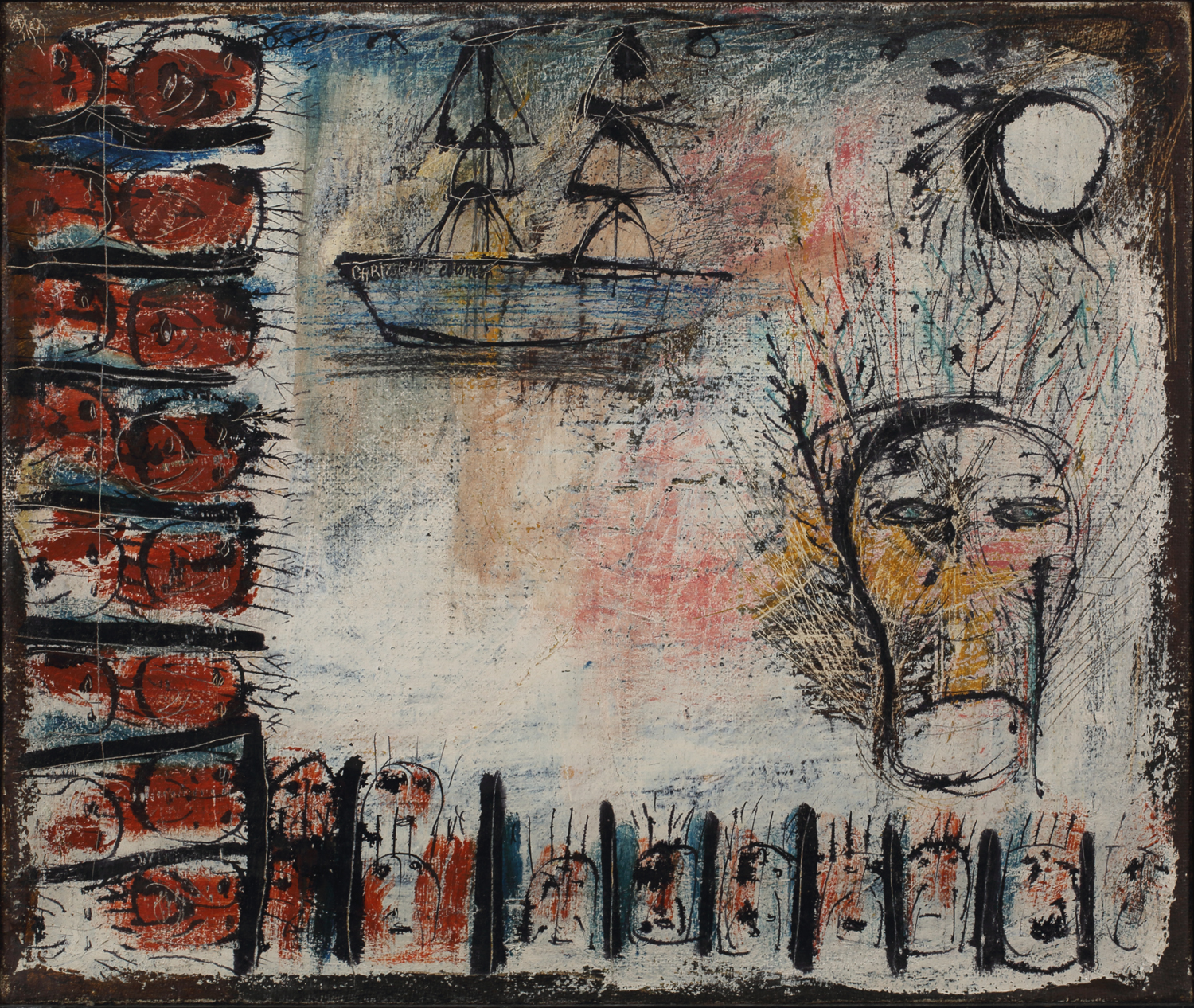
Hommage to Christopher Columbus, 1949
After that you became a French Government scholar, didn’t you?
After Italy, yes. I was in Italy between 1943 and 1948, and when there was a possibility of my obtaining the lascio passare (a pass) for Italy, as, before then, I couldn’t get any document, I lived with Italian ID which I was given and I could never understand why I was entitled to special treatment, because, in those days, the first elections were held in Italy and it was weird. After the liberation and after the fall of that entire Italian construction before the war, there were elections, compulsory voting. One day, I was called up to vote in those elections, I go to the consulate and say, for God’s sake people, I’m a foreigner, I’m not an Italian, I can’t vote. As it was compulsory, I thought that they would accept it, but no, at the moment when you were called up to vote, you have to vote, I’m just saying to what extent all of that was so weird. I was trying to go to France from there. I was lucky then, some Polish painter who lived in Rome founded an international art club for artists, especially for painters and I met him in Rome, and he decided to come to Florence to found a branch there. And he came indeed, we founded that art club. The vice president of the art club, whose member I was, was the French consul. I moaned to him, telling him that I would love to go to France, but that I had no possibilities for that. Well, why don’t you tell me, said he. And then he made a lascio passare (a pass) for me for one month and said: and when you reach Paris, you will settle there so that you won’t need to come back and it was exactly how in fact it happened. I had a brother who lived there since 1925 so, for me, that was the only way from Italy to Paris. I wanted that return, for me that return was very vivid and powerful, just as later was the return to Yugoslavia.
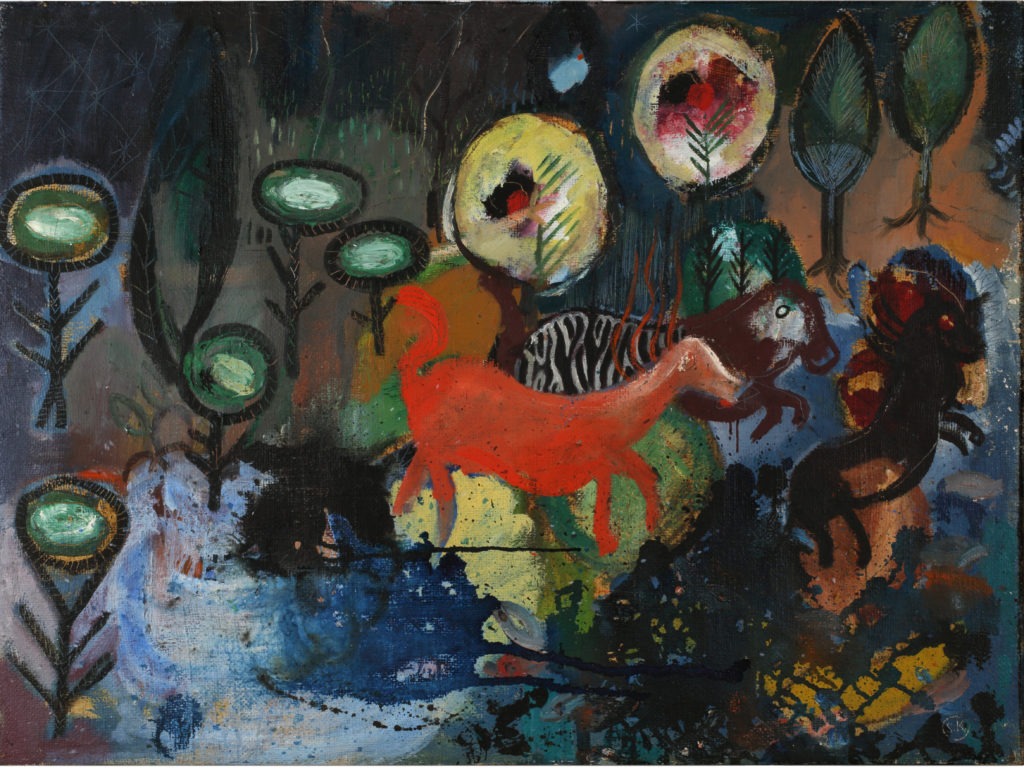
Horses, 1947
And how did you live in Paris then, you lived in Paris, didn’t you?
I lived in Paris. I arrived in France I think on 8th August 1948 and four days after that I met Jean Dubuffet. It was a great encounter, because of what I showed to him, what he showed to me, what we could say to one another, as I was still mixing French and Italian, all of that made us conclude that, although distanced one from another, we walk the same paths, that’s to say, we’re looking for the same paths. And then he engaged me. In those days, the idea of establishment of Art Brut started and I was hired to be responsible for that. This resulted in my being the curator of that gallery for 35 years, of that collection and in my passing through all the phases of its organisation which has now ended up in Switzerland. Dubuffet and I remained in that administrative committee. We annually attend general meetings. He no longer goes there now, it’s too strenuous for him. That was a great encounter. One found all that he maybe secretly admitted to himself. This purification of mine, if we can call it that, started in Italy. I was there during the war, there was a group of people, artists, painters, smart people, who studied big and high sciences and that was a core of those grand, grand reflections and debates. Every day, we would meet in the shadow of that Batister in front of the cathedral, spending hours and hours talking. It started over there; I went through my second liberation there. The first one happened when I arrived in Paris with the French Government grant and when I found Paris in darkness, all the museums closed and all that I had left were walks, looking at those Paris chimneys and that Paris blue sky, which was still so beautiful. And then, it was there that I started liberating myself for the first time; when I came there, I forgot and tried to see the world with different eyes and in a different light than we in Paris used to look at it. And when I came to Paris for the first time, it was in 1939 and my only wish was to see the world in a different way than people in Paris see it. For all of us, Paris was the place where one just had to go. Living without Paris, not knowing Paris, that was a sign that you will never succeed in life or that you would succeed but I don’t know at what price and with what energy. And there is where it all started. I went for walks, galleries were rare, all the museums closed. I met Junek. It was also a great thing in my life because, in a way, Junek was a predecessor, a ram or a standard-bearer. We all got an idea about today’s Paris according to Junek. What the French were never, unfortunately, able to have as Junek was, exhibited more here that over there. Every time, and I had known Junek for years, he was saying that he was preparing an exhibition. And he was indeed preparing it, he made his first exhibition very late. He’s still living today, but he hasn’t been lucky in actualising himself. All that he was working on passed and Junek was left aside. And then we took walks and he would show me around; he was very keen on surrealism and showed me chimneys, we looked at posters, peeled off façades. Those were beautiful days. I call it liberation. It started in France in 1939, continued in Italy in 1943 and since then to date, I believe that it is on side tracks and astray.
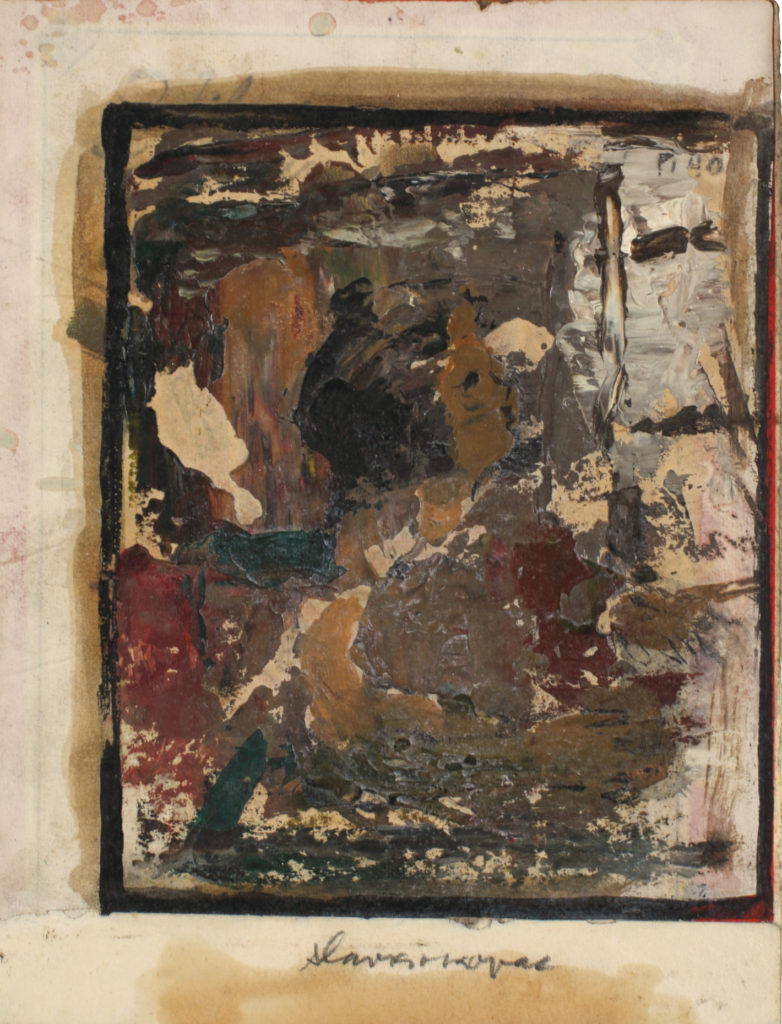
Young girl on the window, 1940
And this is when your acquaintance with Dubuffet was crucial?
Yes, because he was a man who, at that time, was the head of the revolution, he was the one who started applying all those ideas, all those anti-academic ideas, that painting doesn’t have to be engaged and that it doesn’t have to be a result of some heavy knowledge and reflections. Thanks to our first quest for the truth, the Art Brut collection was born; you know what Art Brut is, although you call it ugly art, raw art. It is an attempt to find things which people, who are far from every cultural centre, who don’t know what a museum is, who don’t know what art is, who don’t know what an exhibition is, do and who do it always out of their personal drive and needs. Sometimes, it happens that it lasts an entire life, on occasions it lasts 6 months, but those are always so fresh, so deep and so visually perfect things that one has to admit and say that one can be free only in this way, unattached and distanced from all that this civilisation of ours offers us, with all its possibilities, where every day they programme and condition us with how to spend the day. It is the only healthy and the only important and, I believe, the only one which is entitled to be called art. For all those others, I wouldn’t use that name. I never, or seldom say, that I’m a painter, because I think that it means nothing. And when I say it, I say that I sometimes paint, but that in itself, it is completely wrongly set. Because, a painter is a person who completed the art academy, left with a diploma; it is a person who was set, to whom they started building a small halo around his head and he has that same halo in the street, he carries it at home and everywhere he goes. This halo is already present and the whole life revolves around making it shine as strongly as possible, being richer and dazzling others.
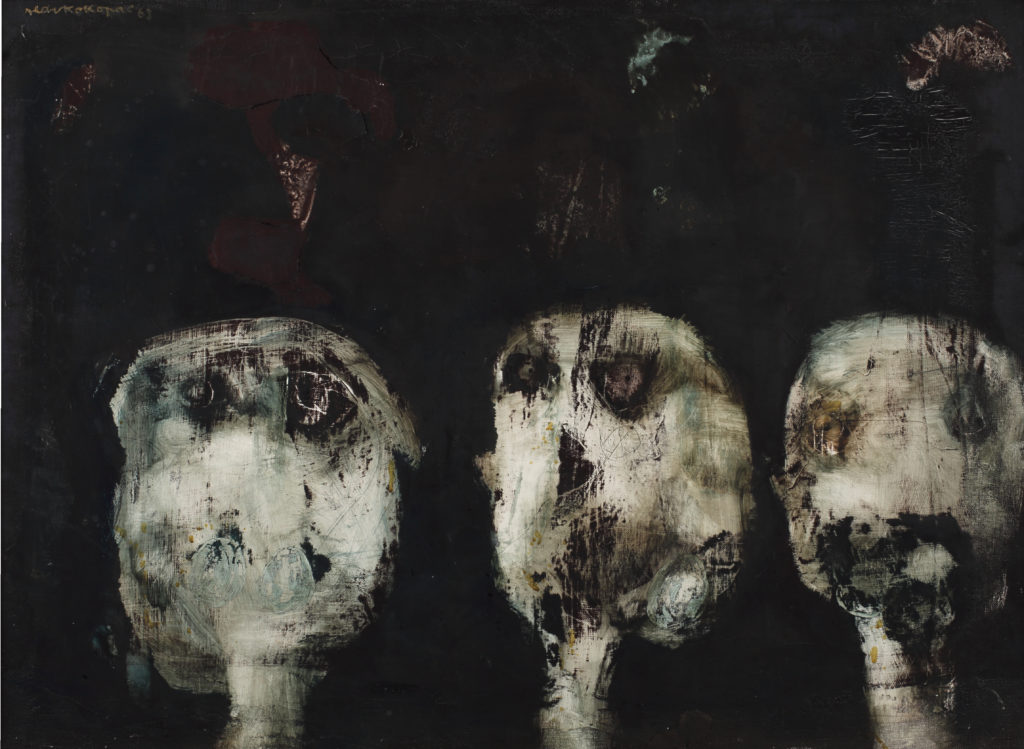
Three heads, 1963
You are actually talking about social success, but a painter does not have to have social success.
That’s what I was saying to you earlier, what does social success mean?
This halo, that means…
At the same time, it means a guaranteed income. This is exactly what bothers me, that to paint, you have to have and make a circle of people around you who will do it and who will, eventually, succeed in making your life easier, allow you to find a beefsteak more easily, pay more easily for it and to bring it home. And this is why I believe that, in that sense, an artist is mistaken, that’s to say, he isn’t mistaken, but puts himself into the position of being subjugated. He has to find that circle of people, must captivate those people with what he creates or let those people captivate him by their wishes, and then he becomes an instrument, he does what a person before him wants of him. So, I think that, in that sense, an artist loses the first trace of freedom and then that halo and that chase for that halo, it is what lies in human nature and, finally, it is not that only bread and wine or bread and milk are important; what is also important is a large apartment, wallpaper is important, northern light is important. So those wishes and those compromises increase from day to day and, in the end, one loses himself and becomes less his own. One would say, becomes, if he is at all lucky and smart, what before was a painter, that’s to say, he’s the document of his time, he has is nothing else to say, he only copies what he sees and serves it to us.
Well, I would not fully agree with you.
I would tell you that there are lot of exceptions and frequently, but the basis lies in it. I also think that, in academies, breadwinners are thus created.
I wanted to say something else, that art, actually, has always been a provider of someone’s wishes and that, in this way, the greatest arts have been created, as, for example, Egypt.
Fine, but there it wasn’t the art of someone’s wishes, it was the art of an entire breathing.
A whole look at the World.
That’s right, equally so in the Middle Ages, it was painted for the glory of God, anyway, it was serving something.
Let us say, for the sake of an idea, in the old Egypt and in the Middle Ages, art was at the service of ideas. In the course of the Renaissance period, it becomes an art, that is to say, serves men.
No doubt about it, but…
And our time is characteristic exactly of the fact that an artist wants to liberate himself from everything.
He would want to want it much more than he’s doing. Certain painters in the Middle Ages and Renaissance had their painters who finished the work for them and who, according to their model, repaired paintings. These are those technicians and they were, most probably, much more talented painters than us who come from the academy today. Today’s Kodak is the one which will picture our reality, record it, for what’s to come. Today, everything is written down, recorded, that moment has no longer any sense. A painter today doesn’t have to and mustn’t be any longer the painter of that reality. Let him turn around, let him become something else, let him sing, go mad, let it be the echo of his being.
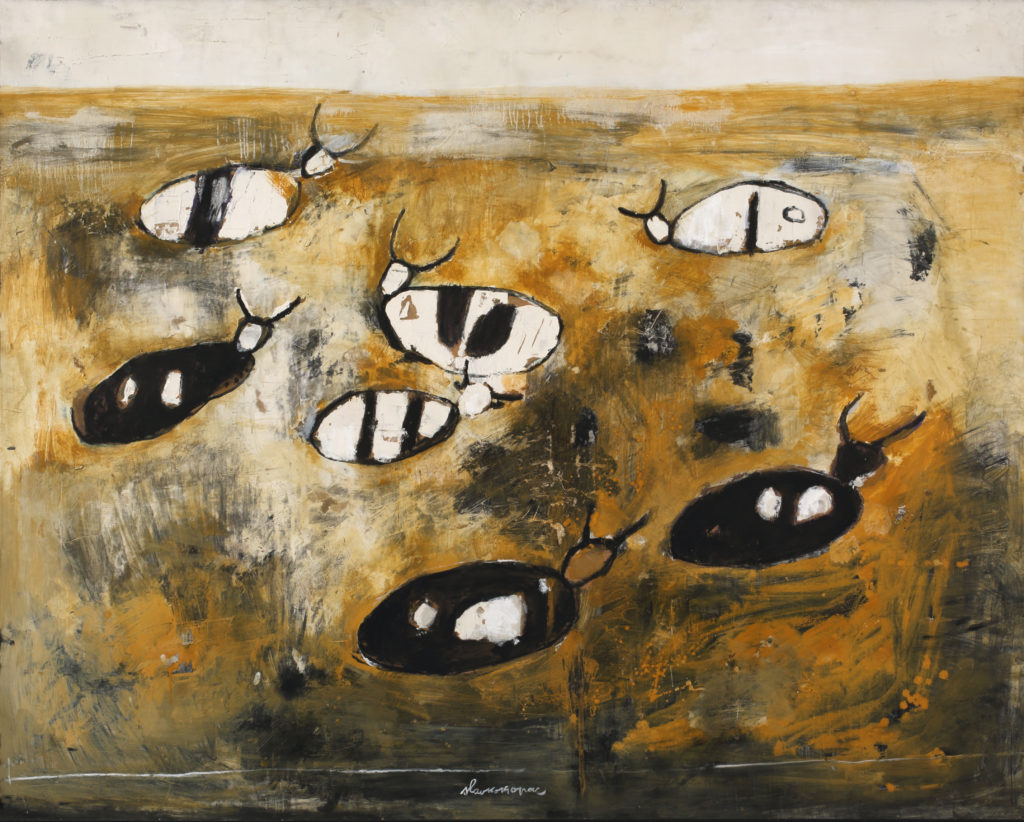
Oxen, 1967
I wanted to say that this need for liberation, for a total individuality of a person, is the characteristic of our time, our century.
That’s right, Picasso was the first to say: “Open the windows!”. I’m adding that it is not enough. Open your windows and doors and not only open but smash the glass, as windows and doors can be closed, that’s why they need to be smashed.
You obviously belong to a revolutionary generation. I think that the later one is far less revolutionary.
Maybe they came to this stadium which preceded and that is “one has to live”. I believe that the most important thing is to turn to your own inside, create and find that cocoon, that hole, and live with a little light which your little light bulb can provide. I told you once, I’m feeling as a great sinner, because, when you’re listening to me, you can say, and say the same thing to myself, how’s this man talking against this professional art, how dare he and how can he accept to exhibit. Because this is in contradiction. I rarely exhibited when I was in Art Brut exactly because I believed that I had to live in line with what I was defending. I was against museums, against galleries, against all that was related to that business. But, in the past, from time to time, I came out in time to make the assessment where I was. And, usually, that was a moment which I consider as necessary and which, even today, seems to me as necessary, but which made me return to my hole as soon and as quickly as possible. And today, I believe that I have reached those years when I have no desires or needs in the sense of luxury, expensive appliances and similar. I can no longer fall into the trap that anyone can deceive me.
So, you are feeling liberated now?
I feel not only liberated, but also free. I told you once that freedom is always very expensive. And I’m telling you now that I had paid a lot for it and that I’m very pleased and that I don’t need anything.
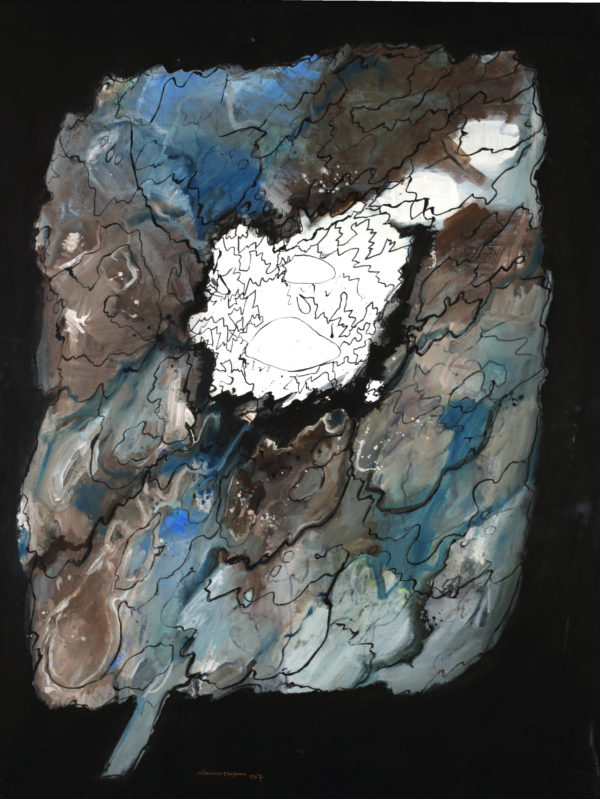
Nest on a tree I, 1967
When I started, we had approximately 200 or 300 documents and, after 35 years, we had around 5 thousand in a large collection and equally so in the collection which houses those (….) of Art Brut since its existence, since there were exhibitions, since it was written about and since we published our periodicals, which now continue to be issued in Switzerland. The world started acquainting with it, the world started being interested in it and everything today that is a little bit outside of some norms, all that smells a little bit of something that is revolutionary, obtains this label Art Brut. So that, actually, there is, thanks to the critics and people who write, a danger of the Art Brut school being created, because, it was concluded, I believe that it’s a way to find solutions for this unfortunate moment, when we no longer know where we’re going, when we are, headless and madly, looking for new paths. It was equally weird as that occasion of meeting Dubuffet. 8 days following my arrival, I entered Art Brut and started there managing that, at that time, small collection, I started that job. Dubuffet then went to El Golea, to paint and look at that Arab world. During that period, Breton, who was in the first Art Brut committee, board, who collaborated with Paulhan and others, replaced Dubuffet and came every day in the afternoon to those premises and so we together looked at what needed to be done, what we needed to reply to and, within about one month, it all started. Breton didn’t know me then at all, to what extent I was a painter, I don’t know, I was always saved again in life by maybe so-called charm; everybody always said it and maybe my whole behaviour, because I’m a man without, they would say in Vinkovci, fussiness, which means direct, so it somehow started and I had my first exhibition in 1949 and that was a big event. I then made with Breton that plaque which was one of his most favourite among all the others ever published. And he wrote there, I made a of sketch how he should organise it and we made it together and together signed it and, for me, it is a bright spot. I’m talking about a man who was exceptionally dear to me, one of the rare gentlemen I’ve ever met in my life. Then, around him, there were Jean Paulhan and Benjamin Péret, who wrote the foreword for my first exhibition. I met Michaux every week at least once in the evening and with Dubuffet. I entered that world which was really closed to everyone. How come? I always say how that small boy from the Vinkovci dust could just happen in Paris and enter what was closed to all. At Breton’s door, there was a paper, no journalists, no reporters, nobody could ring the bell because he had banned it. I socialised with him and what’s nice is that they never intended or wanted to find in me a surrealist painter; they accepted what I brought. I experienced great luck and happiness when our Depolo wrote in a small article about that exhibition of mine at the Modern Gallery, with others, saying: “Kopac is one of our rare painters who went to Paris to take something there and not to take anything from Paris and bring it here”. This seems to me such a big deal that I think that it is possibly the most beautiful thing one could say about me because it actually is one big truth.
It is a very big compliment.
Maybe it sounds immodest that I’m mentioning this to you, but, on the other hand, he wrote that and he will perhaps still also sign it if necessary.
Art critics and reviews
Kopac or Savage Elegance of Being
Slavko Kopac: A Sketch of a Portrait
Jean Dubuffet and Slavko Kopac: A Story about Painters
A Voyage in Informal Art
Au regard des divinités: Slavko Kopac and André Breton
An Exhibition to Remember
An International Adventure in Surrealism, Art Brut and Informal Art
The Hidden Treasure
Kopac, Builder of the Imaginary: "A Different Figuration"
Slavko Kopac: a master at the margins of the visible