Michel Ragon about Slavko Kopac
I met Slavko Kopac for the first time at the bottom of the garden of Editions Gallimard, where the Foyer de l’Art Brut found its refuge after leaving the basement of the Galerie Drouin, Place Vendôme. It was in 1950 and Kopac, who was the secretary of this little palace of popular and naïve wonders, made gouache paintings of strange glowing bestiaries. And then, when the Foyer de l’Art Brut disbanded, Kopac disappeared. One year, Benjamin Péret brought him along to an exhibition at the Etoile Scellée gallery. Then, when I paid a visit to Jean Dubuffet in Vence, he spoke to me about Kopac, whom he considered to be one of the rare remarkable young artists.
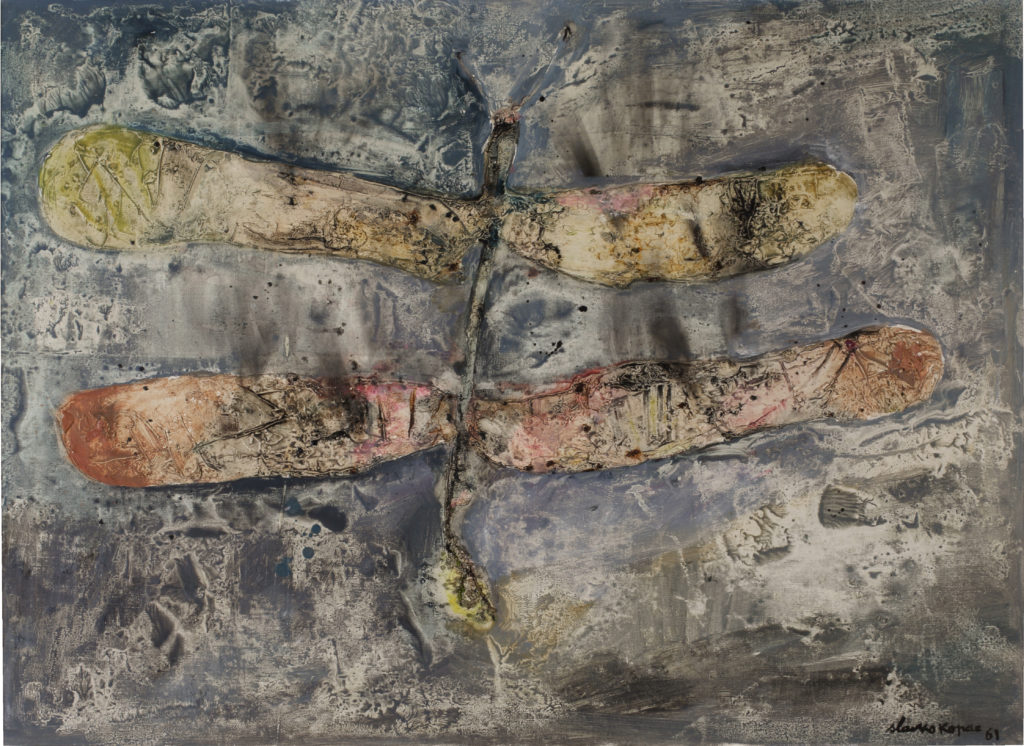
Butterfly leaf, 1961
Depuis dix ans, Kopac travaille dans la solitude de son petit logement montmartrois. Mais le moment est venu, pour lui, d’affronter le public. Son œuvre existe. Elle est là, toute fraîche, inquiète, toute neuve, intimidée de sa propre audace, de son insolente singularité. Nous arrivons à l’époque où un certain nombre d’artistes “en dehors”, dont les œuvres restaient en marge parce qu’elles ne pouvaient pas s’incorporer aux courants qui retenaient l’attention, où ces artistes se mettent soudain à briller de tout l’éclat de leur exemple solitaire. C’est ainsi que nous avons vu l’œuvre de Zoltan Kemeny (de ce Kemeny qui, lui aussi, avait été lié à l’Art Brut) soudain attirer l’attention des amateurs alors que ses “reliefs” n’intéressèrent qu’un tout petit nombre d’happy few depuis que nous vîmes les premiers également aux alentours de 1950.

Twins, 1950
This is also how, during the same decade, Paris didn’t take at all seriously Asger Jorn, leader of the Nordic movement COBRA, who became a new star of the Ecole de Paris. Both of them and Slavko Kopac, who would join them in this new constellation of strange artists, arrived far too early in an artistic milieu, still stuck in traditionalism. The other traditionalism of a good artist abstract painting only overlapped the traditionalism of a good artist figurative painting. As for Kopac, he had nothing at all to do with that. If we had to assign a genre for him, it would be among those artists who, with Dubuffet and Fautrier at the head, make what I used to call, for want of something better: “another figuration”. This is to say that their imaginative and, sometimes, symbolical work is not always sufficiently “legible” for them to be classified among the figurative artists who are strict in their obedience, but which are neither sufficiently abstract (which they are not at all) to be put in the same folder together with non-figurative artists. It, therefore, concerns a different figuration that they propose to us, a figuration of appearances. The figuration of appearances is questionable. Academic rules govern the way in which we see things. This is how most of our fellow citizens believe they look like Hermes of Praxiteles while they actually look like Jean Dubuffet’s characters. So, again, we have the same problem. Visionaries are in fact, true realists.

Motherhood, 1960
A visionary, that Slavko Kopac is deeply. He picks up a stone, a pebble, a piece of wood and, in these dead materials, he instantly figures out a human or animal form, hidden in them. In no time, he brings them to life. This is how we see a stone which turned into a wild boar, others into little men and little women, yet another one into a rooster. The same with his paintings. In the magma of the paste, wonderful butterflies are set in mid-flight. And also birds, flowers, a whole flora and fauna, emerged from Kopac’s fertile imagination, a whole amazing, ingenious, poetic world.
Doubtless, from time to time we will think of Jean Dubuffet, but Kopac’s work, which has some similarities with the work of his great friend from Vence, is nevertheless absolutely different. It is never sordid. It is never fierce. While Dubuffet’s work is a passionate protest against the world, a kind of a pictorial “Journey to the end of the night”, Kopac’s work is ingenious, composed, gracious. His world is sometimes strangely funny, but never grim. It is cheerful, lively work. When looking at Kopac’s paintings, we think of spring.